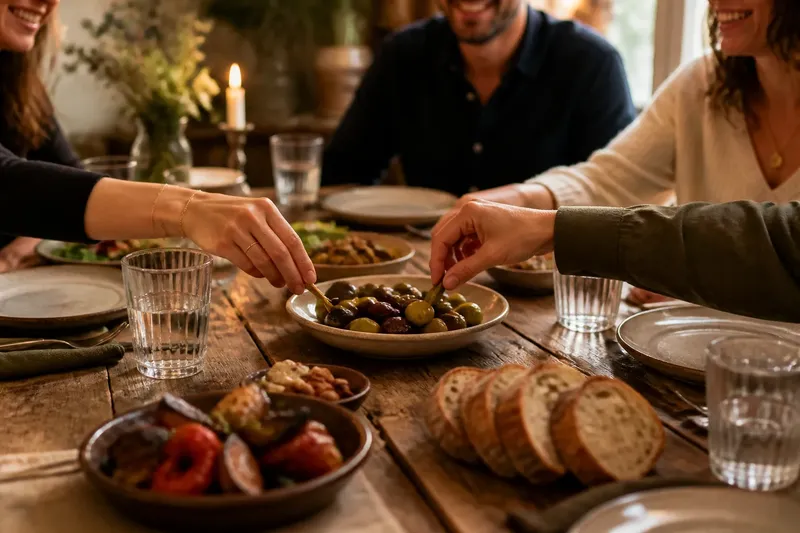
A Potluck with Arrivals Spread Across the Evening
A potluck with staggered arrivals can feel relaxed with clear dish labels, a flexible serving order, and a host plan that welcomes latecomers without a reset.

The first guest sets a covered casserole on the counter while the second is still looking for a place to park. A potluck with staggered arrivals needs a little hosting structure, but not a program that makes everyone feel late. The aim is to let people contribute, eat, and join the conversation at different times without turning the kitchen into a checkpoint.
Use these numbered decisions to make the evening work as a sequence of small openings rather than one grand moment when the doorbell, oven, and serving spoons all demand attention.
1. Choose a loose arrival window
Give guests a window rather than a single minute, and say plainly that arriving within it is fine. If people have work, transit, or family obligations, the window lets them choose a useful time without apologizing for missing an invisible starting gun.
Tell guests what will be happening at the beginning: perhaps tea, drinks, and a few nibbles, with the main dishes opened later. That small note is more helpful than a vague invitation to “come whenever,” which can leave early arrivals wondering whether they should eat and late arrivals wondering whether they have interrupted dinner.
Keep the first part of the gathering low-stakes. Set out water, glasses, napkins, and something that can be eaten without a formal serving moment; avoid making the first dish feel like the meal’s only entrance.
2. Give each dish a useful label
Ask contributors to bring a card with the dish name and a short ingredient note. At the table, the card helps guests make choices without requiring the cook to repeat a description over the sound of a coat zipper and three overlapping conversations.
A useful label can include:
- The dish name, written in ordinary language.
- Notable ingredients, especially common allergens such as nuts, dairy, eggs, or wheat.
- Whether it is intended to be served warm, cool, or at room temperature.
- Any serving utensil the dish needs, such as a ladle or tongs.
- The contributor’s name, if guests may want to ask about the dish.
Keep labels factual and brief. A card that says “bean salad, contains sesame, serve cool” gives more useful information than a charming paragraph that leaves the sesame buried in the last line. For food-safety questions, follow the dish’s handling guidance and applicable local rules.
3. Set a first-table menu
Choose a few items that can greet people before the full spread is assembled: bread, olives, sliced fruit, or a bowl of crackers, for example. These are not meant to replace dinner; they give early arrivals something to do besides inspect the oven and ask whether they should help.
Keep this first table separate from the dishes that need coordinated serving. A small tray or cleared corner can hold the early food, while the main table remains available for later arrivals and the larger meal. The separation also makes it easier to add new contributions without dismantling the place where people are already eating.
Say where the first food is and whether guests can help themselves. A simple sentence at the door prevents the host from making repeated announcements while trying to find a corkscrew.
4. Open dishes in a flexible order
Do not make every dish wait for a single synchronized opening. Start with foods that are ready to eat, then add substantial dishes as they arrive and as the table has room. A pot of soup can join the meal when it is ready; a salad can wait until there is space beside it.
Think in broad groups rather than a strict course sequence: early nibbles, filling dishes, then sweets or fruit. The order can bend around what guests bring. If the only dessert arrives early, it can stay covered until people want it; if a hearty dish arrives late, it can become the next thing served rather than a regrettable encore.
Imagine a guest arriving after the first few people have eaten from the bread and olives, carrying a tray of roasted vegetables. You can add the tray to the main table, point out its label, and invite the new arrival to make a plate without asking everyone else to begin again.
5. Make the serving table easy to read
Arrange the table so guests can see what is available before picking up a plate. Put labels beside dishes, keep serving utensils with their food, and leave a clear patch for contributions that are still on their way. A crowded table creates a small puzzle at exactly the point when people are holding plates.
Place dishes that need spoons or ladles where those utensils can rest without sliding into neighboring food. Put plates and napkins at one end, and make a clear route along the table so guests do not have to reach across a casserole to find a fork.
For a small room, a sideboard or kitchen counter can hold backup dishes, while the dining table keeps only what people are serving now. The spread need not appear all at once to count as dinner.
6. Keep late arrivals in the meal
When someone arrives after the main table has opened, greet them before giving a recap of everything they missed. Point out what is still available, where the labels are, and whether any dish is being held back. That is enough orientation; the guest can learn the rest from the room.
Keep a little food aside only when it is practical and safe to do so. A covered portion on a separate plate can welcome a late guest, but dishes that need specific temperature handling should be managed according to their instructions rather than left out indefinitely.
Do not stop the conversation for a second toast or a fresh round of introductions unless the group genuinely wants one. A late arrival can join the current conversation, and the host can offer a quiet introduction to nearby guests when there is a natural pause.
7. Agree on helpful contributions
When inviting people to bring food, ask what they plan to bring and mention a few useful categories that are still open. This is not an attempt to curate the evening into a perfect menu. It simply makes it less likely that every guest arrives with a bowl that needs the same oven shelf.
Tell contributors whether you have serving dishes, refrigerator space, or a way to warm food. Ask them to bring a serving utensil if they can, and to label the dish before setting off. Where the right handling depends on a label, manufacturer instructions, or local rules, those directions take precedence.
Leave room for a contribution that does not fit the plan. A potluck is partly a meal and partly a collection of people’s choices; the host’s job is to make those choices easy to share, not to grade them at the door.
8. Use a quiet host routine
Before guests arrive, clear one surface for incoming dishes, set out labels and a pen, and choose where the main table will be. Keep a few serving spoons and a roll of paper towels nearby. These modest preparations reduce the number of decisions you must make while answering the door.
During the evening, check the table when there is a pause: add a label, move an empty platter, or make space for the next dish. You do not need to announce each adjustment. A host who keeps the room legible can spend more time among the guests than beside the serving spoons.
A potluck with staggered arrivals works best when the food has more than one point of entry: an easy first bite, a flexible main table, and a clear way for latecomers to join. Leave a pen beside the labels. Someone will eventually need to identify the unclaimed bowl, and “the green one” is not a durable record.