The Authenticity Shortcut: Why One Dish Can Have Many Versions
Learn why one dish can have many authentic versions, and how ingredients, households, and occasions shape the choices behind a recipe.
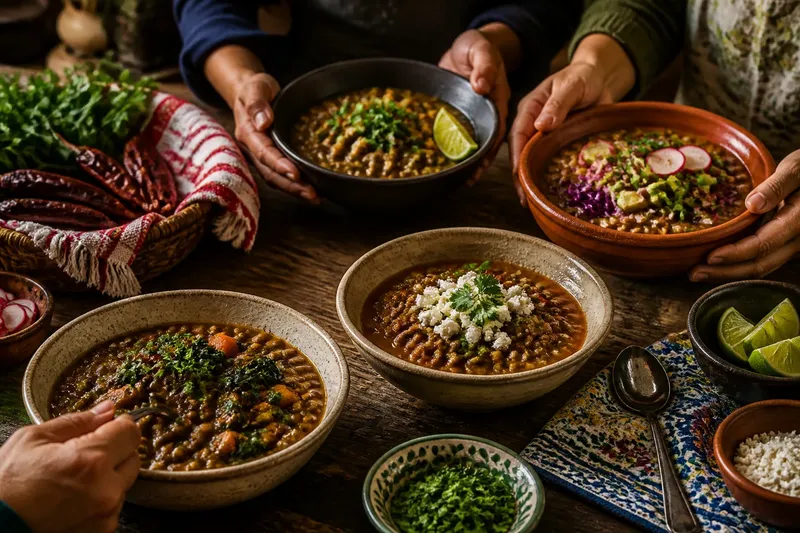
At a family table, the same stew may arrive with more broth than last time, a sharper chile, or a handful of greens that were not in the recipe someone copied down. That does not make one bowl authentic and another suspect. The authenticity of a dish often lives in the choices people make around it, not in a single fixed list of ingredients.
For anyone asking why one dish can have many authentic versions, the useful answer is that recipes are shaped by place, household, season, and occasion. A written recipe can preserve one expression of a dish, but it cannot stand in for every kitchen that has made it.
One name, many dishes
A dish name usually points to a family resemblance rather than a rigid formula. It may identify a main ingredient, a cooking method, a flavor profile, or a place of origin. The exact boundaries can vary from one community to another, and even from one household to the next.
That flexibility is not an invitation to call any unrelated preparation by the same name. A dish still has recognizable features: perhaps a particular grain, a sauce built in a certain way, or a characteristic balance of sour, salty, and aromatic flavors. But those features leave room for variation in quantities, substitutes, texture, and serving style.
Think of a recipe as a local map rather than a border fence. It shows a route that works; it does not prove that every other route is false.
Ingredients carry local conditions
Ingredients change with climate, markets, migration, cost, and availability. A cook may use a different bean because it grows nearby, choose a dried chile sold at the neighborhood store, or substitute a preserved ingredient for a fresh one outside its season. Such choices can reflect practical knowledge, not a departure from tradition.
Even an ingredient with the same name can differ in moisture, sweetness, heat, or texture. A recipe written for one kind of tomato may behave differently with another. Cooks adjust by taste and appearance, often without treating that adjustment as a separate recipe.
Imagine a cook preparing a familiar lentil dish in a place where the usual leafy green is unavailable. They use a locally common green with a similar cooking time, then adjust the amount of liquid as it softens. The pot may differ from a relative’s version, yet the method and flavor logic remain recognizable to the people who make and eat it.
When an ingredient is unavailable, consider what role it plays before choosing a substitute: body, aroma, acidity, heat, or color.
Households make their own standards
Recipes are often learned through repetition, observation, and correction. One person prefers a thicker sauce; another cooks the onions longer; someone else adds an ingredient only when feeding a larger household. These preferences become part of what a family recognizes as its version.
Household differences can also reflect equipment and daily routines. A heavy pot retains heat differently from a thin pan. A cook with little time may cut vegetables larger or use a preparation that reduces active work. The resulting dish is shaped by the kitchen as much as by the recipe on the page.
There is no need to turn every family preference into a claim about an entire region. “This is how my aunt makes it” is useful information. “This is the only authentic way” is a much larger claim, and usually a less careful one.
Occasions change the recipe
A dish served on an ordinary evening may be lighter or simpler than the version made for a holiday, a ceremony, or a gathering of relatives. The occasion can affect ingredients, labor, presentation, and the amount prepared. A celebratory version may include components that are too costly or time-consuming for routine cooking.
Food also changes when it travels between home and restaurant kitchens. A restaurant may use a more consistent preparation for service, while a household cook adjusts from one day to another. Neither setting automatically owns the more authentic version. Each responds to different constraints and expectations.
Seasonal cooking adds another layer. A dish may be made with fresh produce when it is abundant and with dried, stored, or preserved ingredients at another time. Those differences can be part of the tradition rather than evidence that the tradition has been diluted.
How should authenticity be judged?
Does a recipe need one fixed ingredient list?
No. A recipe can describe a recognizable version without accounting for every local ingredient or household preference. The more useful question is whether its choices fit the dish’s cooking logic and the community or family tradition being described.
Can a substitute still feel traditional?
Yes, especially when the substitute serves a similar role and reflects what is available to the cook. A change made for convenience may also become familiar over time, though it should not be presented as the only established version.
Who gets to call a version authentic?
People connected to a dish through cooking, eating, and local knowledge have relevant perspectives, but no single person necessarily speaks for every household. Be specific about whose practice you mean: a family, a neighborhood, a region, or a particular restaurant style.
What if two versions conflict?
Describe the difference rather than forcing a winner. One version may be associated with a particular household or occasion, while another reflects a different ingredient supply or local preference.
Describe the version, not a verdict
When discussing a dish, name the details that make a version distinct. Say which ingredient is used, how it is prepared, and when or by whom it is commonly served, if that information is known. That description gives readers something concrete without turning one cook’s practice into a universal rule.
If you are cooking from a family recipe, ask about its cues as well as its quantities. “Cook until the onions smell sweet” or “stop when the sauce coats the spoon” may explain more than a fixed amount. These observations help preserve the reasoning behind the recipe, even when the ingredients available to the next cook differ.
For a published recipe, be clear about whether it represents one household’s version, a regional style, or an adaptation. Do not use “authentic” as a synonym for old-fashioned, exotic, or unmodified. The word carries a claim about belonging, and the claim deserves precision.
One dish can have many authentic versions because food traditions are practiced by people in particular kitchens, with particular ingredients and reasons for cooking. The next time two bowls differ, ask what each one is responding to. That question is often more revealing than asking which bowl wins.